http://www.uoregon.edu/~natinit/initiative.htm
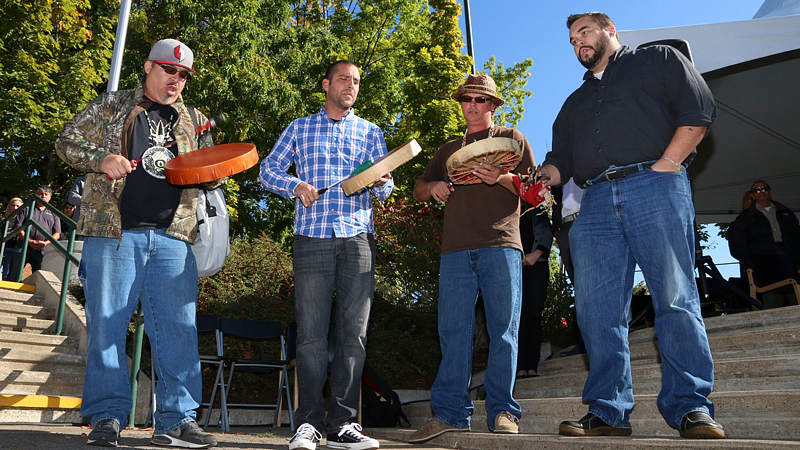
A May 10, 2003 groundbreaking ceremony for the Many Nations Longhouse marked another milestone for the University of Oregon’s Native American Initiative, a comprehensive effort to enhance recruiting and retention of Native American students and faculty, increase academic and social support for native students, and foster a core of programs that will make the UO a major center for American Indian education and research.
The initiative, begun by former UO president Myles Brand and further refined and developed by current president Dave Frohnmayer, is driven by an alliance of Native American faculty and staff members, students and university officials. It encompasses many programs and ideas forged at the UO over the past decade to learn from and serve the Native American communities and individuals of the Northwest.
The Native American Initiative represents long-standing and expanding relationships between the UO and the nine federally recognized tribes of Oregon—the Coos, Coquille, Grand Ronde, Klamath, Siletz, Siuslaw, Umatilla, Umpqua and Warm Springs.
Component Areas of
Initiative
Ø
Student Access
and Support
The UO has increased access and academic support for its 204 (spring 2003) Native American students. Elements include new centers and institutes such as the Center for Indigenous Cultural Survival, the Northwest Indigenous Language Institute and the Southwest Oregon Research Project. They also include a program for residency by aboriginal rights, which grants enrolled members of tribes whose traditional lands include what is now Oregon, the right to pay in-state tuition regardless of where they live; special attention to Native American student recruitment and retention; academic support through the Office of Multicultural Affairs; a new full-time coordinator for Native American Enrollment Services; and an enhanced scholarship program. Active Native American student organizations on campus include the Native American Student Union; Native American Law Student Association; Native American research interest group at the Center for Study of Women in Society; and American Indians in Science and Engineering Society.
The
university makes a concerted effort to recruit, support and mentor Native
American graduate students. From 1992-2002, 82 Native American students earned
graduate degrees and 27 earned law degrees at the UO; some graduate students
have chosen the campus longhouse as the site to defend their thesis
dissertations.
UO
Department of Anthropology faculty members and students, as well as staff
members of the UO Museum of Natural History, work closely with Native American
communities of the Pacific Coast to preserve and protect native archaeological
sites. Building on an extensive history of Native American scholarship that
started with Luther Cressman in the 1930s and continues with the work of faculty
members Jon Erlandson, Madonna Moss, Mel Aikens, and others, the UO is at
the forefront of changes that align the field more directly with the interests
and needs of native peoples.
Under the leadership of Rob Proudfoot, Six Nations Seneca Haudesaunee, an award-winning professor in the UO International Studies Program, the university has developed the Center for Indigenous Cultural Survival, the only international program in American higher education devoted to the study and preservation of indigenous cultures around the world.
Former
UO School of Law Dean Rennard Strickland, of Osage and Cherokee heritage,
is a nationally known scholar of Native American law, art and culture. Associate
professor Mary Wood’s work on tribal environmental issues is being used by
federal agencies in developing national policies. Native American environmental
and sovereignty issues have been at the forefront of the UO’s annual environmental
law conference. Past speakers include Carl Sampson, chairman of the Umatilla
Tribe; Ted Strong of the Inter-Tribal Fish Commission; Winona LaDuke of the
White Earth Recovery Project; and Huanani-Kay Track, who discussed Hawaiian
sovereignty.
The U.S. Department of Education’s Office of Indian Education awarded $1.06 million to a consortia of nine Northwest tribes and the UO College of Education. Funded through the Indian Professional Development Program, the three-year grant to the “Sapsik’walá” (Teacher) Program will support the education, recruiting, training and mentoring of American Indian teachers. The program’s aim is to increase the number of native teachers who have the professional development and cultural sensitivities necessary to help lower the high dropout rates and raise test scores at schools with high populations of American Indian students.
Shari
Huhndorf, an Alaska native, director of ethnic studies and associate professor
in the UO English department, provides Native American literature courses and
has written books on Native American literature, history and culture. In 1997
the Oregon Humanities Center sponsored a Native American Literature Conference
at the UO, which featured such noted American Indian authors as N. Scott
Momaday, Joy Harjo, James Welch, Wendy Rose, Pat Hilden and Robert Allen
Warrior.
The
UO campus has become a focal point for tribal and community gatherings in
Oregon. In May 1997, leaders of coastal Oregon tribes gathered for the first
time in more than a century for a potlatch ceremony on the campus. During
the ceremony, leaders of the Coquille tribe, in conjunction with the UO Graduate
School and Knight Library, presented to the tribes of Southwest Oregon copies
of some 60,000 pages of documents on tribal history and culture. The documents
were found and organized as part of the Southwest Oregon Research Project
(SWORP). Another groundbreaking potlatch in June 2001 brought together representatives
of 44 Western Indian tribes for the first time in at least 150 years, to celebrate
the recovery and presentation of an additional 50,000 pages of archival material
by SWORP researchers.
Programs, Projects and
Groups Relating to Initiative
UO chapter of national organization provides an array of
programs and presentations which can benefit the cultural and physical
development of native student from any discipline.
The CICS, through its collaboration with indigenous people
and their communities, serves to increase the understanding of the challenges
faced by indigenous peoples and to support the continuance of their diverse
cultures. The CICS staff consists entirely of indigenous
people.
http://darkwing.uoregon.edu/~cics/center.htm
Ø Many Nations Longhouse
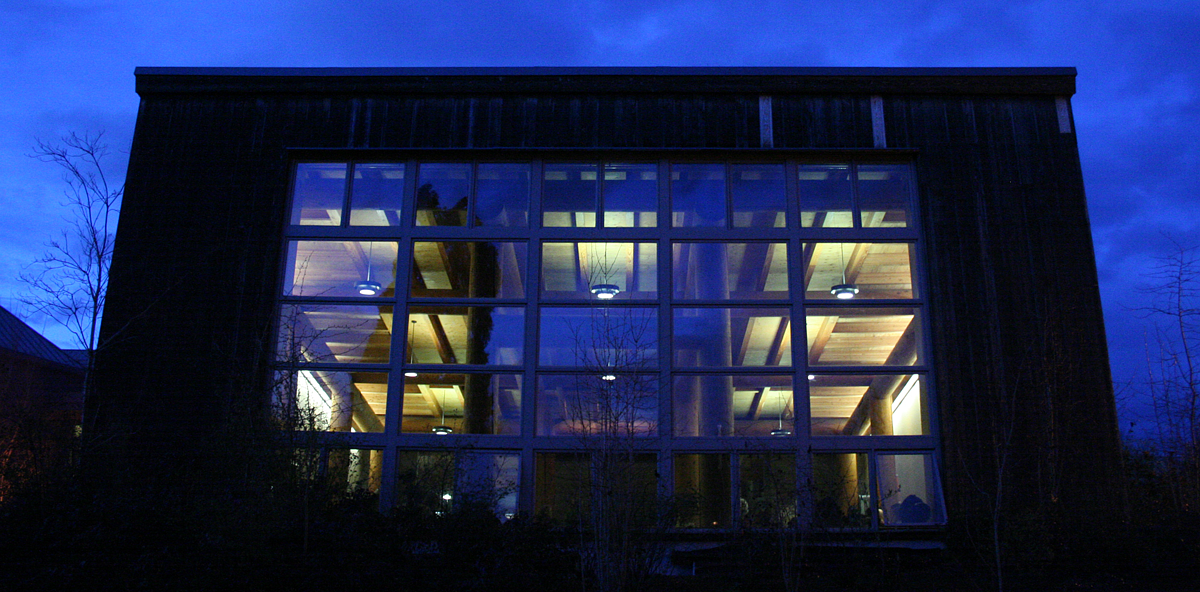
The $1.2-million longhouse on the UO campus—expected
to be completed by spring 2004—replaces the retired Native American Longhouse,
which for 30 years served as an Oregon tribal meeting place for graduation and
potlatch ceremonies, annual powwows, feasts and informal potlucks, drumming and
singing, and classes in Native American crafts. Seattle architect
Johnpaul Jones, a 1967 UO architecture graduate and a designer of the
Smithsonian Institution’s National Museum of the American Indian, designed the new longhouse to express the cultural
values of Oregon’s native communities; reference the historic form of some
native dwellings in Oregon; and promote interaction between the university and
Native American communities, as well as indigenous peoples of many
cultures.
http://www.uoregon.edu/~committees/longhouse/LonghouseDevelopment/
Faculty, students, and community members engage in weekly
discussions of topics related to Native American, Alaskan Native, and other
indigenous cultures worldwide. Topics include research issues, literature, film
and other academic subjects.
http://csws.uoregon.edu/rigs/rNative.shtml
Ø
Native American Student Union
(NASU)
NASU is a student-run organization that provides academic,
social and cultural support for the Native American community on campus. It
hosts three powwows a year; sponsors events and conferences; offers educational
advising; holds weekly meetings; provides a voice for native students within the
student government; and honors Native American graduates each year in a
blanketing ceremony at the spring powwow.
http://gladstone.uoregon.edu/~asuonasu/
Each summer, this UO English department program brings a
multicultural group of incoming freshmen to the university to get an early start
on their college careers. Designed as a recruitment tool for Native American
students, the program offers full tuition, room and board, and book expenses for
as many as 12 students who share a deep interest in Native American and
multicultural issues. Participants are selected through a competitive
process.
http://www.uoregon.edu/~bridge/ http://cas.uoregon.edu/alumnidev/cascade/200110bridge.html
Ø
Northwest Indigenous Language Institute
(NILI)
Offered through the UO linguistics department in
partnership with Northwest tribes, NILI provides training and tools to help
native people of North America maintain their culture through the learning and
teaching of their native languages. It creates opportunities for native people
to restore their languages of heritage to a central place in their communities.
http://babel.uoregon.edu/nili/
http://www.uoregon.edu/~natinit/initiative.htm
Ø
Sapsik’walá (Teacher) Program
“Sapsik’walá” is a Sahaptian word meaning “teacher.” In
partnership with the nine federally recognized tribes in Oregon, the UO College
of Education prepares American Indian teachers through a master’s degree
scholarship program to meet the needs of native students. The program started
with two students in 2002 and has funding for about 20 in 2003. As of April
2003, the program has received 28 applications and accepted 17 students for fall
2003.
http://education.uoregon.edu/sapsikwala
Ø
Southwest Oregon Research Project
(SWORP)
Started in 1995, SWORP involves the repatriation of 110,000
pages of archival documents from the National Anthropological Archives and
National Archives in Washington, D.C., to 44 tribal nations in the greater
Oregon area. Involves UO anthropology researchers and members of the Coquille,
Siletz, Coos, Siuslaw, Lower Umpqua and Grand Ronde
tribes.
http://darkwing.uoregon.edu/~coyotez/index.html
Select
Numbers
Ø
A
record 228 American Indian/Alaska Native students enrolled at the University of
Oregon in the fall of 2002, up 21% from the 188 who enrolled in the fall of
1997. Reflecting a retention rate of 90% for the year, 204 of these students
remain enrolled in spring term 2003. On average, the university retention rate
for American Indian/Alaska Natives and all students is about 84%.
Ø
The University of Oregon had 38 American Indian/Alaska
Native faculty and staff members in 2001-02, an increase of 52% from the 25 in
1995-96.
Ø The
representation of American Indian/Alaska Native officers of administration at
the university increased from .94% in 1994 to 2.02% in 2001.
Contacts (Areas of
Expertise)
Ø
Gordon Bettles, interim Steward
of the Many Nations Longhouse. (Coordinates Longhouse User Group, provides
liaison to Northwest Tribes, links Longhouse project to all aspects of University
Native American programming.)
e-mail gbettles@oregon.uoreogn.edu
Ø
Az Carmen,
coordinator for Native American enrollment services, University of Oregon
(UO efforts to recruit, enroll and retain
native students, related statistics, program information)
(541) 346-0681
(office), (541) 343-2758 (home); e-mail azcarmen@oregon.uoregon.edu
Ø
Johnpaul Jones, architect for
Many Nations Longhouse and a Native American UO alumnus
(Design elements and cultural considerations
of UO longhouse and other Native American sites)
(206) 624-5702; e-mail info@jonesandjones.com
http://www.jonesandjones.com/office/jj/index.html
(Leadership of the Center for Indigenous Cultural
Survival, Details of graduate teacher education scholarship program for Native
Americans)
541) 346-1056; e-mail foot@oregon.uoregon.edu
Ø
Pat Rounds, director
of Sapsik’walá Program, UO College of Education
(Details of graduate teacher education
scholarship program for Native Americans)
(541) 346-1056; e-mail plrounds@oregon.uoregon.edu
Ø
Dr. Dave Hubin, executive assistant
president, University of Oregon
(Intergovernmental relationships between university
and tribes, longhouse project, link to Presidential leadership in overall
initiative)
(541)
346-3036; e-mail hubin@oregon.uoregon.edu